
The Liberal George Allen
We might expect that having such a prolonged association with Ruskin and the Ruskin household George Allen would have adopted many of their conservative and traditional views. We might also gain the opinion that he was polite and duly subservient throughout his working life with Ruskin. The fact is, though, that any perception we might have of George Allen’s character comes principally from Ruskin’s biographers, and in the spirit of the age he had been viewed by them merely as Ruskin’s ‘man’ and of the working or at best, the trade class, and as such became little more than a footnote in both metaphoric and literal senses in studies of Ruskin’s life. A few reports of Allen’s loyalty do exist, as do others of his obstinacy and the very occasional admissions of his long-suffering at Ruskin’s whims, but in general terms he has been relieved of any traits of personality. Edward Cook’s 1890 publication. Studies in Ruskin1 is one of the rare instances of any biographer of Ruskin actually speaking with that one person who had worked longest at his side. Allen had, it would seem, been unintentionally shielded in anonymity for years. With textual references so rare he might also remain ageless in the reader’s mind, forever regarded as the young man from the Working Men’s College. It is useful, therefore, to be reminded that he was in his twenty-fifth year and newly married when Ruskin engaged him as his assistant/secretary/trainee engraver. By the time that Ruskin had decided to publish his own work in 1871, Allen was thirty-nine, and at the time of Ruskin’s first serious breakdown Allen was forty-six. With Ruskin’s health and stability declining, by the time Allen reached his mid-fifties he was running the publishing of Ruskin’s works, seeking other authors to bolster the catalogue, and in control of the finances. When he helped carry Ruskin’s coffin to its resting place in Coniston Churchyard, he was sixty-eight.
George Allen was, of course, intensely loyal to Ruskin and although privy to all aspects of Ruskin’s character and fortunes during the finest and the worst of his days, he ‘kept his own counsel.’ Chapter seven of Cook’s book is based on interviews with Allen and has the title ‘Mr. Ruskin and the Booksellers’ and is also the first printed account that gives any credit to Allen for his successes in maintaining and increasing access to Ruskin’s work in the marketplace. Allen’s forty years beside Ruskin placed him in a uniquely special place which was realised by John Howard Whitehouse, in whose opinion “no other living man has had closer connection with the dead prophet. We hope that Mr Allen will one day issue his reminiscences of the Master. They would be of rare interest, and ought not to be lost to the world. We know no man better qualified to tell the story of Mr. Ruskin’s personal life.” 2 That book was never written. Allen’s life took on its greatest challenge following Ruskin’s death with the production of the thirty-nine volume Library Edition of Ruskin’s works while simultaneously working to protect Ruskin’s literary output over the question of copyright on each individual title ever printed. These two enormous tasks filled every day of the remainder of Allen’s life.
A wealth of correspondence passed between Ruskin and Allen while Ruskin was travelling abroad, and again as the Allen family lived independently from the Ruskin household. When Allen’s thoughts regarding his engraving work and decisions at the publishing house are added to the Allen family’s own notes and reminiscences, some surprisingly liberal attitudes come into view. An early example dates to 1884 when, having been encouraged by Ruskin to add other authors to his catalogue, Allen was approached by a certain Mrs McFall with a manuscript titled ‘Ideala, a Study from Life.’ Allen sent the manuscript to Ruskin seeking his view on the matter, as although the publishing business was moving over to Allen’s management, Ruskin was still taking a firm interest. Ruskin’s letter of reply was principally to deal with matters regarding a future edition of Fors Clavigera, but such was his frustration with Allen over even considering the McFall manuscript his words exploded onto the top of the page:
“I return to you that accursed stuff you sent to ask if you might publish! What an awful mess you’ll make of the business when you’ve not got me to look after you – if you know no better than that!” 3
So, what was Ruskin’s great objection to Mrs. Frances McFall?
Frances was born in 1854 in County Down, Ireland where her father, a naval lieutenant, was stationed. Following his death in 1861, Frances and her four siblings were taken by their mother to live near relatives in Yorkshire. With little money to support them Frances was often forced to ‘go without’ in order that her brothers might be raised as gentlemen, an experience she would often recall with bitterness. She became disappointed by the reality of what passed for girls’ education at that time, finding it unable to develop her intellect, and like many young women, escaped an unhappy childhood through the expedient of an early marriage. Her husband, Surgeon-Major David Chambers McFall was a thirty-nine-year-old widower with two sons, one of them only six years younger than his bride. As so often happened, that escape led to imprisonment in an unhappy marriage.
Of course, Ruskin would probably have known nothing of this, only of the presented text of Ideala and what it stood for: a fictionalised account of an unhappy marriage and a subsequent divorce that detailed the lack of a woman’s legal rights in Victorian society. It was a subject too uncomfortable for Ruskin and to make matters even worse – horror of horrors – Mrs. McFall was a Feminist Activist! Allen must have read the manuscript before passing it to Ruskin, having had no personal concerns upon the subject matter. The manuscript was duly returned to McFall who, remaining unsuccessful in finding a publisher, published the book herself in 1888. Modest profits from the venture enabled her to leave her husband and settle in London and embark upon a literary career, reinventing herself as ‘Madame Sarah Grand.’ Ideala would later be taken on by the publisher Richard Bentley, but when he sold his business to Macmillan in 1898 it was William Heinemann who took the rights on McFall’s list (further titles had been published by then) and re-issued Ideala. Remaining in print for more than a century, it may well have become one of Allen’s best-selling titles other than the Ruskin list if he had not been denied the opportunity by Ruskin. McFall (now Sarah Grand) would go on to lecture throughout England and the United States in the early decades of the twentieth century promoting women’s suffrage and the Rational Dress Society who protested against the introduction of any fashion in women’s dress that either deformed the figure, impeded the movements of the body, or in any way tended to injure the health such as tightly-fitting corsets. She was also a member of the Women Writers’ Suffrage League and the vice-president of the Women’s Suffrage Society. Under her pseudonym Sarah Grand, she openly attacked the double standards of Victorian sexual morality and campaigned for the recognition of women’s rights, especially in the context of health and education. She was, without doubt, a force to be reckoned with. If all of that would not have been enough to disturb Ruskin, it appears that McFall was also a pioneer woman cyclist, and dressed in trousers to ride – and Ruskin had recently made his clear his views in the Press on that pastime:
I not only object, but am quite prepared to spend all my best ‘bad language’ in reprobation of the bi-, tri-, and 4-5-6- or 7 cycles, and every other contrivance and invention for superseding human feet on God’s ground. To walk, to run, to leap, and to dance are the virtues of the human body, and neither to stride on stilts, wriggle on wheels, or dangle on ropes, and nothing in the training of the human mind with the body will ever supersede the appointed God’s ways of slow walking and hard working. 4
So wrote Ruskin in March that same year, two months after the excoriating letter to Allen. It is
interesting to note, and to wonder, if Ruskin was aware that the previous year Allen had written to his brother in law John Hobbs that he found relaxation after his long and stressful working hours as a keen cyclist. As he wrote to Hobbs:
We have 4 machines here. I have my own special tricycle which no one else uses then I bought another for general use of the boys and a tandem also for general use, then Hugh has his own bicycle […] I enjoy a run immensely myself and can do my 30 or 40 miles without a break and with a little practice I believe I could do 80 miles or more in a day. 5
We find then, that Allen is not always in agreement with Ruskin, and certainly not avoiding the century’s new technologies or societal challenges. Ruskin may not have regretted the decision to reject the manuscript, and George Allen would have put it out of his mind, but it is a strange coincidence worth mentioning that when Allen’s ‘Ruskin House’ publishing premises at 156 Charing Cross Road were vacated a few years later, they were taken on by the Suffragette Movement as a shop for their publications, pamphlets and the miscellaneous items that we today call ‘merchandising.’
Allen’s plan to add new authors to his catalogue continued, and picked up in the last decade of the century as it had become clear that Ruskin could produce no new work and although many old works still reprinted and sold well, new authors were essential for the business to survive. Also important for success in the marketplace was the need for stylishly illustrated books so, as well as commissioning established names and traditional styles in illustrative work, Allen sought out new and rising talent. The shrewd business mind saw the cost benefits of employing younger men and women. Allen unhesitatingly commissioned his artists, illustrators and translators without gender discrimination; something not at all commonplace in Victorian times. It is likely that these young people at the start of their careers were willing to work for less than experienced artisans while hoping that Allen’s name and reputation would boost their fortunes, and as it often turned out, many of them went on to enjoy long and successful careers.
In 1893 George Allen began preparing a set of three Jane Austen titles for a planned ‘Masterpieces of English Fiction’ series of books, the first of which was Pride and Prejudice. Here, once more, we see Allen’s independent thinking. Any conservative restraints over cover designs were set aside as he commissioned the successful and popular illustrator Hugh Thomson to produce the stunning ‘peacock’ design for the cover, now one of the most sought-after arts & crafts examples of book design with fine copies attaining high four-figures sums. Emma and Sense and Sensibility were also at the planning stage but with Thomson in great demand, Allen approached Chris Hammond – full name Christiana who had shortened her name in an attempt to hide her gender – to provide the plates in the text, and for two more arts & crafts styled covers he commissioned the designer and binder Angus Turbayne, a young American finding success in England. These two titles, although less spectacular than Thomson’s peacock, now approach four figure sums for good copies.
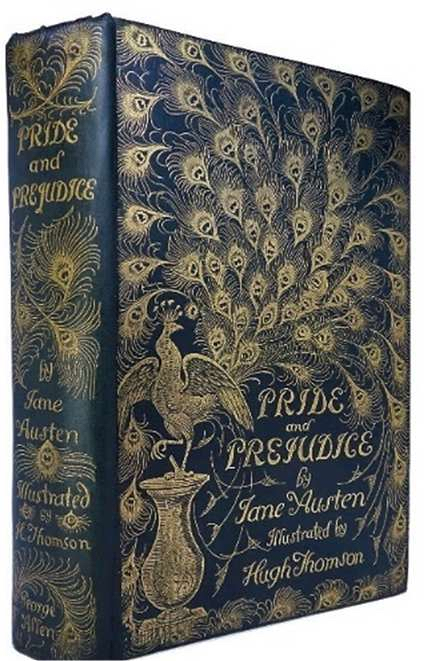
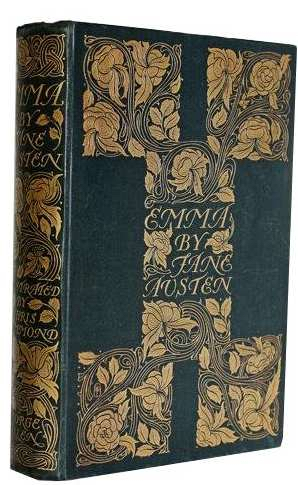
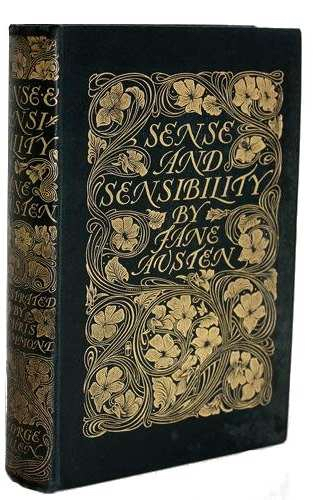
Left to right: Pride and Prejudice, cover and illustrations by Hugh Thompson (1894), Emma (1898) and Sense and Sensibility (1899), cover design by Angus Turbayne with the text illustrations by Chris Hammond).
Another woman artist Allen took on for a number of projects was Emily J. Harding (1850-1940), also known under her married name as the women’s suffrage activist Emily J. Harding-Andrews. Besides providing cover and text illustrations she also provided the translation from the French for George Allen with his Fairy Tales of the Slav Peasants and Herdsmen (1896). Many other titles would feature Harding’s translation or illustrative talents over the next few years. By then, Ruskin would not have been able to comment on these books so we can only speculate as to his views.
Arthur Gaskin (1862-1928) caught Allen’s attention working in the style of Walter Crane while exhibiting at the 1893 arts & crafts exhibition in London. Gaskin would go on to become one of the most successful and sought-after nineteenth century illustrators, working briefly for Morris at the Kelmscott Press, and from there to great success in a variety of craft formats. Gaskin’s illustrations for Allen’s 1897 version of Hans Andersen’s Fairy Tales were a part of the 1893 exhibition.
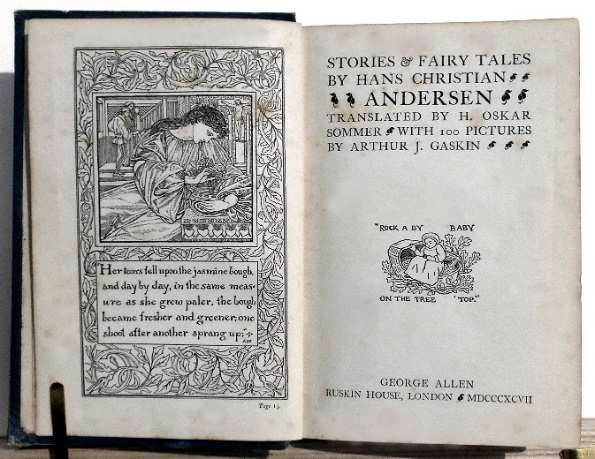
Hans Andersen’s Fairy Tales, illustrated by A.J. Gaskin (1897).
Line engravings and decorated llustrations throughout, woodblocks cut by Bernard Sleigh.
Commissioned to undertake Gaskin’s illustrations for Hans Andersen was Bernard Sleigh (1872-1954), a young wood engraver just starting out on his own after having been apprenticed at just fourteen years, who in later years would record his first meeting with George Allen: “I remember vividly meeting Allen at tea in Gaskin’s studio; a rather severe, quick-spoken man with a grey beard and hair just turning. He was pleasant enough to such a youngster as myself, the rate of payment was arranged, and a monthly delivery of finished blocks. That he was John Ruskin’s publisher I could not forget.” 6 Sleigh developed into a multi-disciplined artist in many genres. He joined the Society of Mural Decorators and Painters in Tempera and was one of the first to enrol in the Birmingham School of Art’s new stained glass course in 1900.
Fred Mason (1864-1939) was another member of the Birmingham School of Art. Working in the style of Walter Crane, he provided stunning illustrations for several of Allen’s titles but in spite of recognition and awards, he abandoned his freelance work and took a post as head of the Taunton School of Art where he remained until his retirement, producing only occasional commissions for his graphic artwork until his retirement. Houen of Bordeaux was published in 1895, one of several titles for Allen around this time.
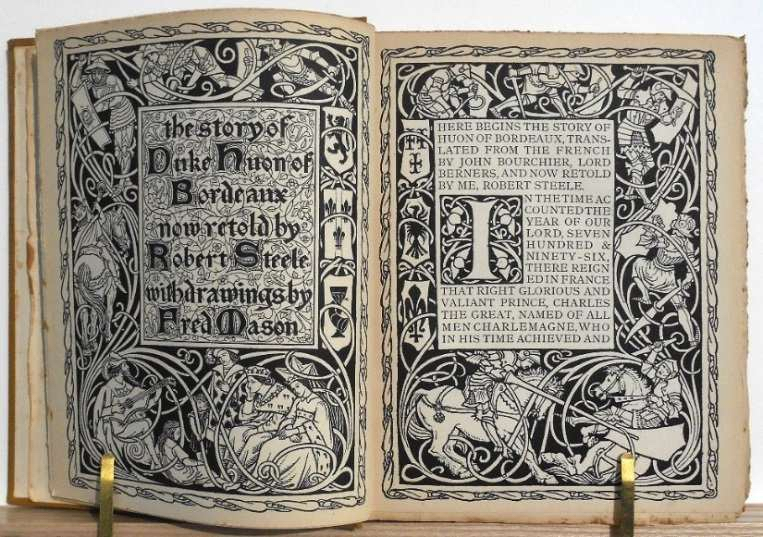
Huon of Bordeaux: Done into English by Sir John Bourchier, Lord Berners: and now retold by Robert Steele (1895). Numerous full page and single page illustrations by Fred Mason throughout the text, (1895) and undoubtedly influenced by William Morris.
Paul Woodroffe (1875-1945) was a young student at the Slade School of Fine Art when Allen first commissioned his work. In full arts & crafts style, The Second Book of Nursery Rhymes (1896) used the wide spread of the opened pages to display wonderful borders around the music score on one side, with its appropriate illustration on the facing page. As his precocious talent matured and with his reputation established, Woodroffe went on to join Ashbee’s arts & crafts community at Chipping Campden. Becoming also a talented artist in stained glass, he would later design and make a set of windows for Lady Chapel of St Patrick’s Cathedral on Fifth Avenue in New York.
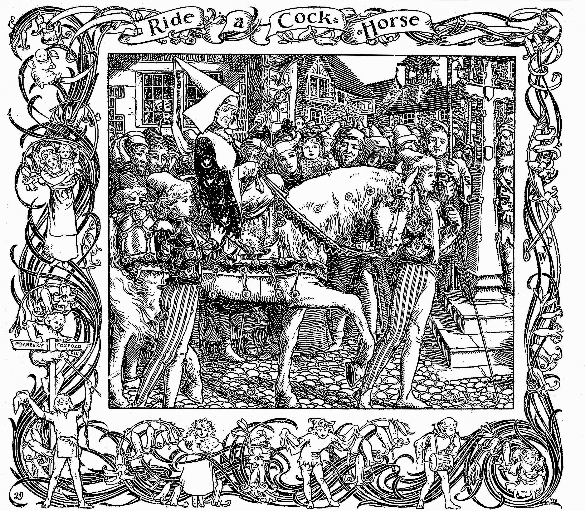
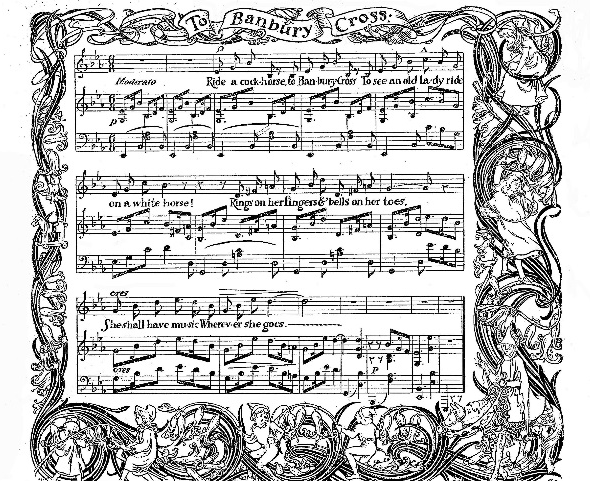
The Second Book of Nursery Rhymes (1896).
The list could go on, but enough has been included to show that Allen took on young artists, regardless of politics or gender and treated them fairly with both wages and opportunities. Not only did many go on to long and sucessful careers, but also worked over and again for Allen during the following years which in itself is testament to his fair and even-handed manner. He was able to give many of them their first experiences of working for publisher or printer and to teach them the proper protocols and procedures for presenting their artwork. Along the way relationships were formed that would bring opportunities in what we might well consider as the golden age of book design. It was a period when art nouveau and arts & crafts and imagery was at its height and these new, young artists used the improving processes of the embossing and gilding on covers to invigorate book design.
As with all ages and fashions, there were designers pushing the frontiers of taste and style and the demand for artistic innovation was high. Allen’s choices of the new designs or little known designers and artists produced some times surprising results, such as the striking cover of Tales From Bocaccio (1899). Against a black background, a figure with bobbed black hair and of no clear gender, stands wearing a floor length gown of a rich deep green on which black hearts the size of a hand cover it from top to bottom. One hand protrudes from the gown at chest height, holding a bright red book open and facing upward to be read. It is minimialist in style. The other feature of the cover is a swirling scroll that contains the title, author and illustrator in gold text on light green background, and where the scroll is turned so the we see the reverse, it is the deep green of the gown. It swirls downward to the right, over the train of the gown that extends towards the right corner of the cover, giving balance to the striking design.
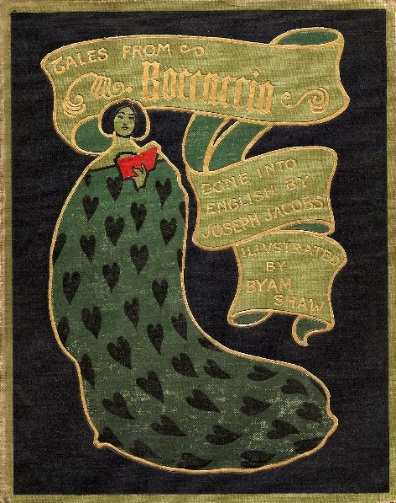
Spectacular cover design and illustrations by Byam Shaw for
Tales from Boccaccio Done into English by Joseph Jacobs (1899).
Whether or not Ruskin would have wished to see novelty or humorous titles on Allen’s list we are left to guess but Allen needed with some urgency to expand his market as not only was there was no new work from Ruskin but the reprint market was also beginning to slow. Allen identified a growing interest in children’s books that could exploit the new, bright colours of letterpress colour printing, and alongside that, a further growth in educational books for schools that incorporated similar attractive design elements. Allen brought the same high standards into this new part of his catalogue and was able to compete successfully with much larger publishers who already had an established place in the market.
Perhaps the children’s story titled ‘The Nightingale, dished up on China plates’ is as far from publishing Ruskin as we can imagine, with a cover showing a comical dragon playing a banjo, and Chinese styled capital lettering. Both text and all illustrations as well as the cover were from the mind of R. Andre, a prolific illustrator, mainly of children’s books in the 1880s and 1890s.
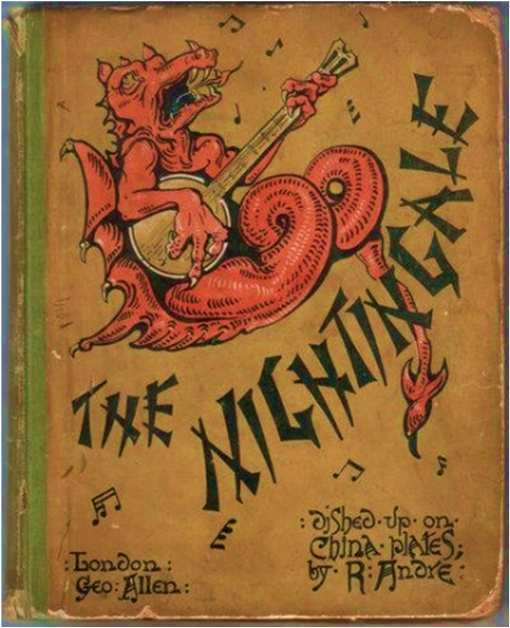
The Nightingale dished up on China plates. Text and illustrations by R. André (1899).
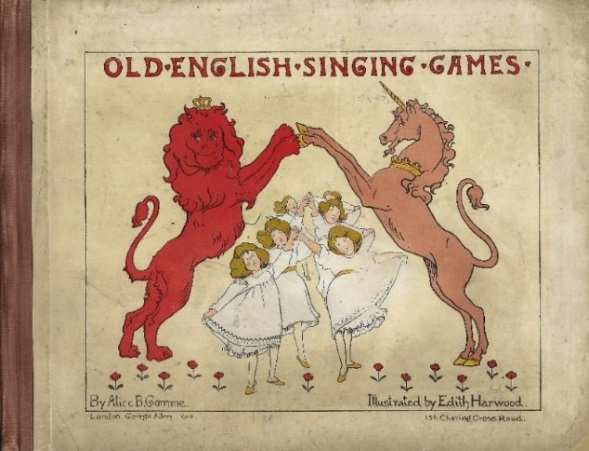
Two further examples of children’s titles, both landscape and of large format with chromo lithographed covers and pages are representative of another style ofAllen’s output. Tom the Piper’s Son is based on the children’s nursery Rhyme and has a charming image of a farmer, his wife and daughter dancing in an idyllic country landscape with happy cows and a frolicking pig, taken from watercolours by T. Butler Stoney who did much work for Allen in various styles. Old English Singing Games is a companion in style and colour and is full of delightful watercolour images by Edith Harwood reproduced once more with chromo lithographed plates. To have such colour throughout must have been rather a novelty at the time.
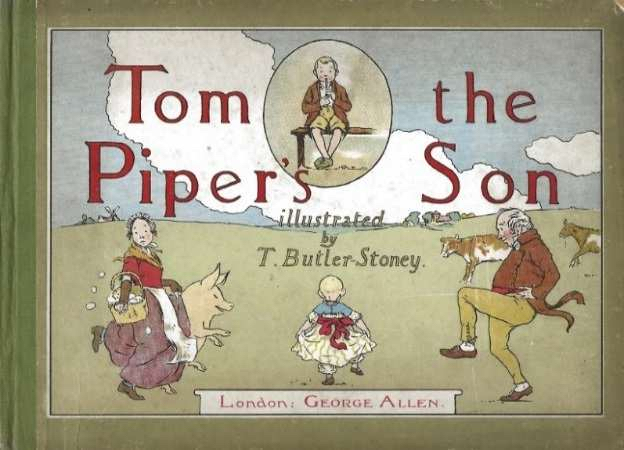
Left: Tom the Piper’s Son. Illustrated by T. Butler Stoney. Full-page chromolithograph plates, printed by
Thomas N. Storer Sons & Co of Nottingham and London. (1900).
Right: Old English Singing Games. Illustrated by Edith Harwood. Full-page chromolithograph plates, printed by
McLagan & Cumming, of, Edinburgh. (1900).
The last sample to be included is an indication of the range and breadth of Allen’s catalogue It is a teaching book called The Child’s Picture Grammar that uses comical pictures and simple rhymes to aid reading and understanding the tasks of the various parts of grammar. The cover is typical of the humour throughout, with two large exclamation marks that have ach been given eyes and an open, surprised mouth. Other characters that inhabit the pages appear there and also on the title and text page sampled below. Being ideal for home teaching or in schools, this was an opportunity for repeating sales over a long period.
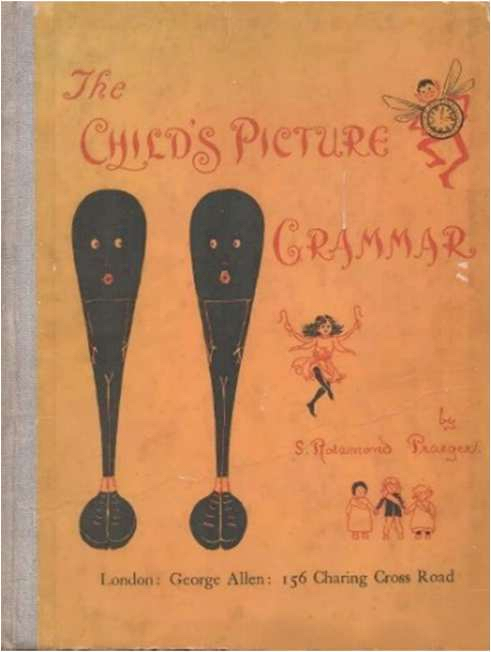
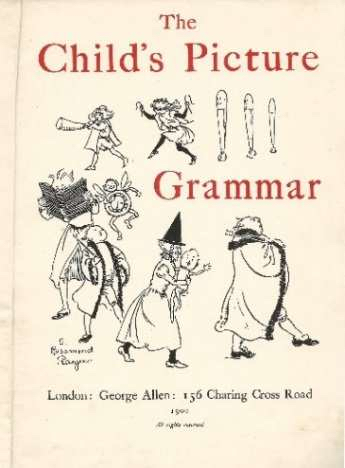
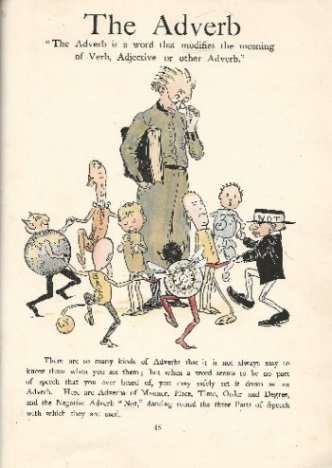
The Child’s Picture Grammar (1900).
Text and line illustrations by S. Rosamund Praeger with eight chromolithographed plates, printer not
named. Most copies of this book have been passed on or shared many times over and are
often found coloured-in or scribbled upon and with covers worn and loose.
Few have survived, making this well-used book is a very rare survivor.
It becomes clear that Allen was highly attuned to his marketplace and had a discerning eye for contemporary design and market trends, as a detailed survey of his publications demonstrates.7 Increasingly, the decisions he made regarding commercial and artistic commissions may not necessarily have been Ruskin’s, but were crucial to secure not only Ruskin’s legacy with funding reprints of his titles, but also for Ruskin’s financial security along with that of Brantwood, the Severns, as well as Allen’s own family.
We are more and more able to see George Allen as a pragmatic, independent thinker. But what of Allen’s home life, and what does it tell us of his tastes and attitudes?
As with everything about Allen’s life, much of it was centred around Ruskin’s plans. His first family home after marriage was the Lodge House (or Gatehouse) at 163 Denmark Hill from 1857 until 1862 when at Ruskin’s behest the Allen family packed up and moved with him to France where they stayed until 1864 at Le Villa Gaullier in Mornex. On their return they rented a house in Bromley, before moving to more suitable premises at Keston. Apart from the brief spell at Bromley, Heathfield Cottage at Keston was the first home that was independent of continual oversight and physical connection with the Ruskin household. Here, they kept chickens, grew their own vegetables, and Allen tended his beehives. It was to be their happy haven for several years until the growing family, in both size and number, struggled to co-exist with the ever-increasing volume of Ruskin’s published works being stored there. Their last and most significant removal was to Sunnyside, Orpington, Kent, in the home financed by a loan from Ruskin, designed by a cousin of Allen, and built under the direction of Allen’s uncle, the experienced builder to whom he had been apprenticed in his youth.
The Allen family of seven children moved into Sunnyside in February of 1874, its design most certainly influenced by George Allen. It is in the style of a Victorian Gentleman’s Villa, with some arts & crafts flourishes where the budget would allow. Local clay roof tiles gave a warm orange glow in the sun and the contrasting ‘London Yellow’ brick chimney stacks stood tall into the sky, but where the budget could not stretch, Allen and his architect planned a few trompe l’oeil flourishes, uch as the windows on the front face of the house which appear to have gothic arches. The windows were, in fact, rectangular with contrasting terra cotta-coloured bricks forming a decorative arch above each window. This arch was boarded with horizontal timber, cleverly stained to give a similar dark effect as the window panes beneath. Perhaps it was these features that prompted Ruskin’s tongue-in-cheek comment, “I like your cockney gothic” to George Allen on his first visit to the finished building. 8
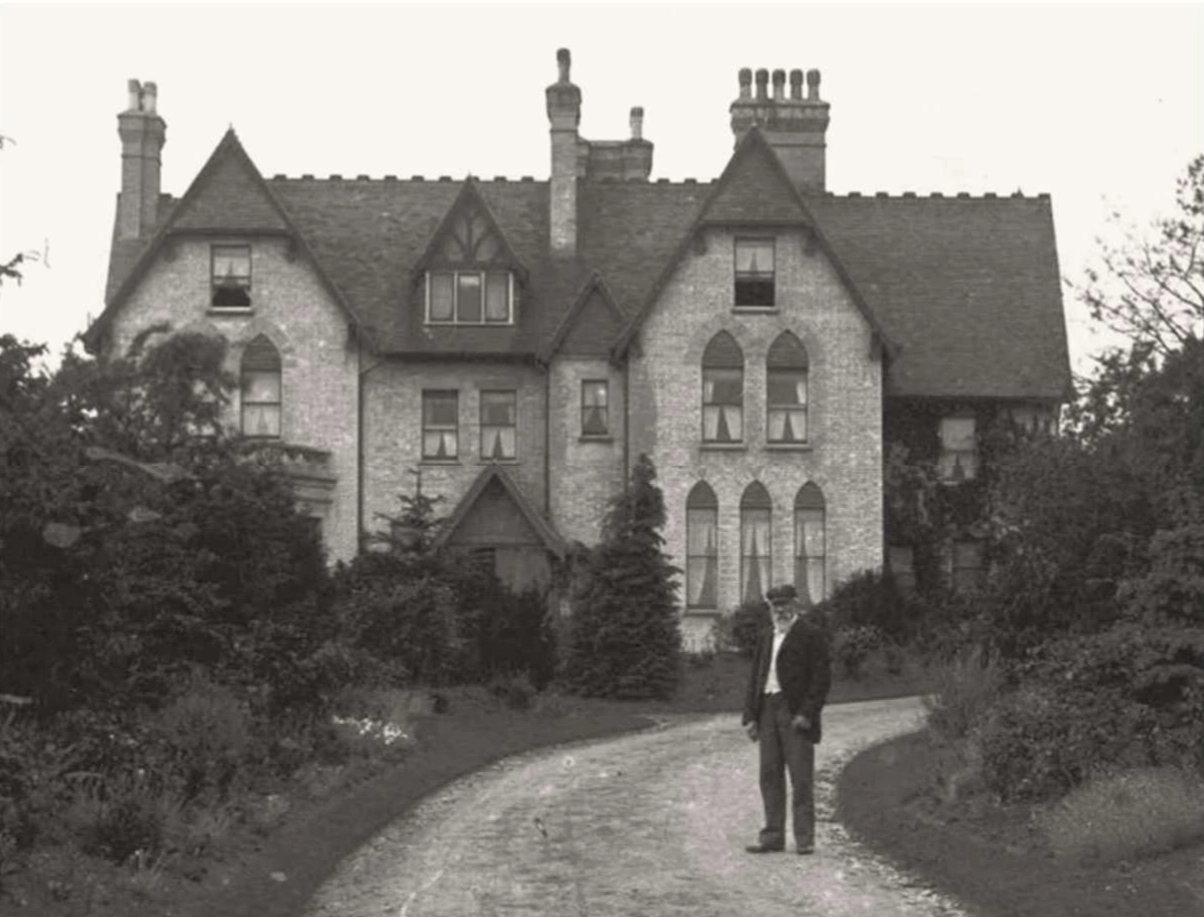
George Allen in the drive at Sunnyside, c. 1905
Sunnyside is where the growing family flourished, and where we look to see Allen’s taste, style, and manner of living expressed for the the first time truly independent of Ruskin. For the next forty years it would be the home of the Allen family and its walls would witness both births and deaths as generations passed through, while reflecting a family’s evolving tastes in their furnishing and decoration. It is to those same walls we look, quite literally, to see them when photographed in the first decade of the twentieth century when Harrods’ Estate Agency prepared what has turned out to be a valuable evidentiary historical document: the Auction Catalogue for the Sale of Sunnyside. Alongside the executors’ house sale, the Allen family prepared other catalogues to disperse their father’s vast collection of books, bindings, paintings and other works of fine art following his death in September of 1907. The photographs reproduced in these catalogues indicate the scope of Allen’s taste and the breadth of his collections, and provide a truly remakable record.
The photographs in the auction catalogue show an entrance hall with dark panelling, heavy gothic furniture and heavy drapes at each door suggesting that winter drafts need to be kept at bay. Three doorways lead off the hall, partly hidden by those drapes, one to the morning room and another to the dining room where we can catch a glimpse of a number of framed paintings. If the visitor was a little disappointed, thinking that he had entered a rather conservative, even old-fashioned home behind the arts and crafts flourishes to the external design, that idea would have been swept aside on entering the third door that takes us into the expansive drawing room. Extending the full depth of the house and well-lit from windows at both ends, this drawing room this was a bright sun-filled room with curtains that could be pulled over to protect the framed paintings that covered all of the walls. An upright piano faced into the room suggesting that music was a shared enjoyment for the family, and has a Japanese- inspired embroidered pattern to hide the piano’s heavy frame. Some traces of Victorian furnishings survive alongside the late century aesthetic movement styles of side tables and the slender turned spindles of the dining chairs.
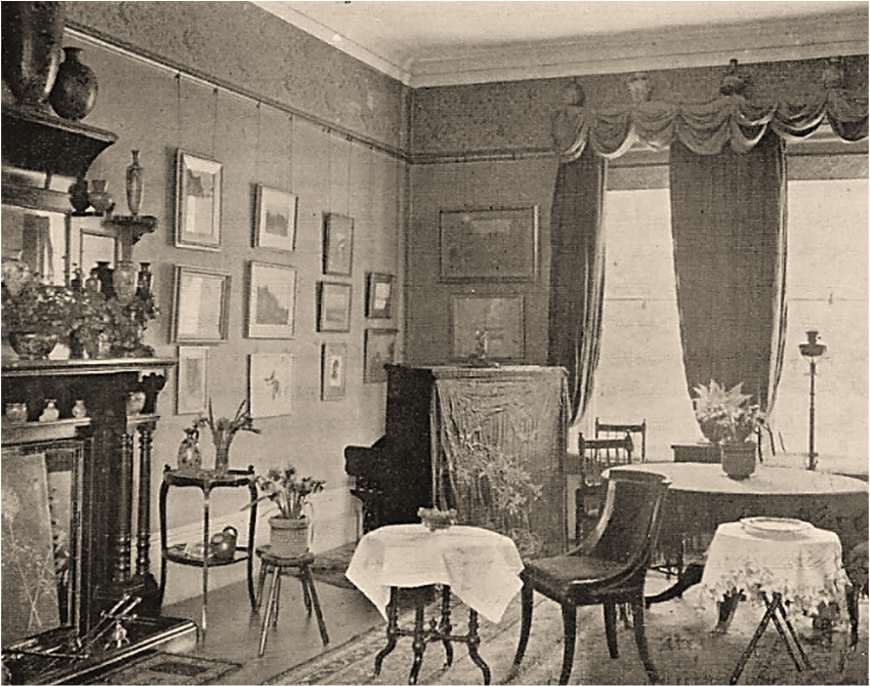
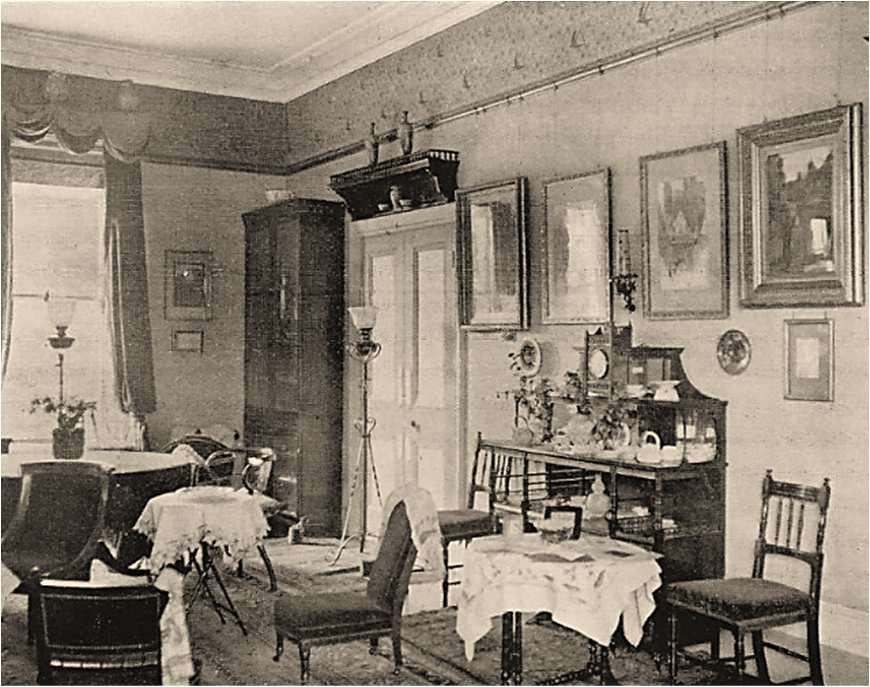
The drawing room, west and east sides.
It is in the expansive drawing room where we begin to understand the extent of Allen’s collections, and although the walls are covered from waist height to ceiling with framed pictures, surely the most striking thing the guest would see on entering the drawing room is the large fire surround centrally placed and dominating the room with its presence.
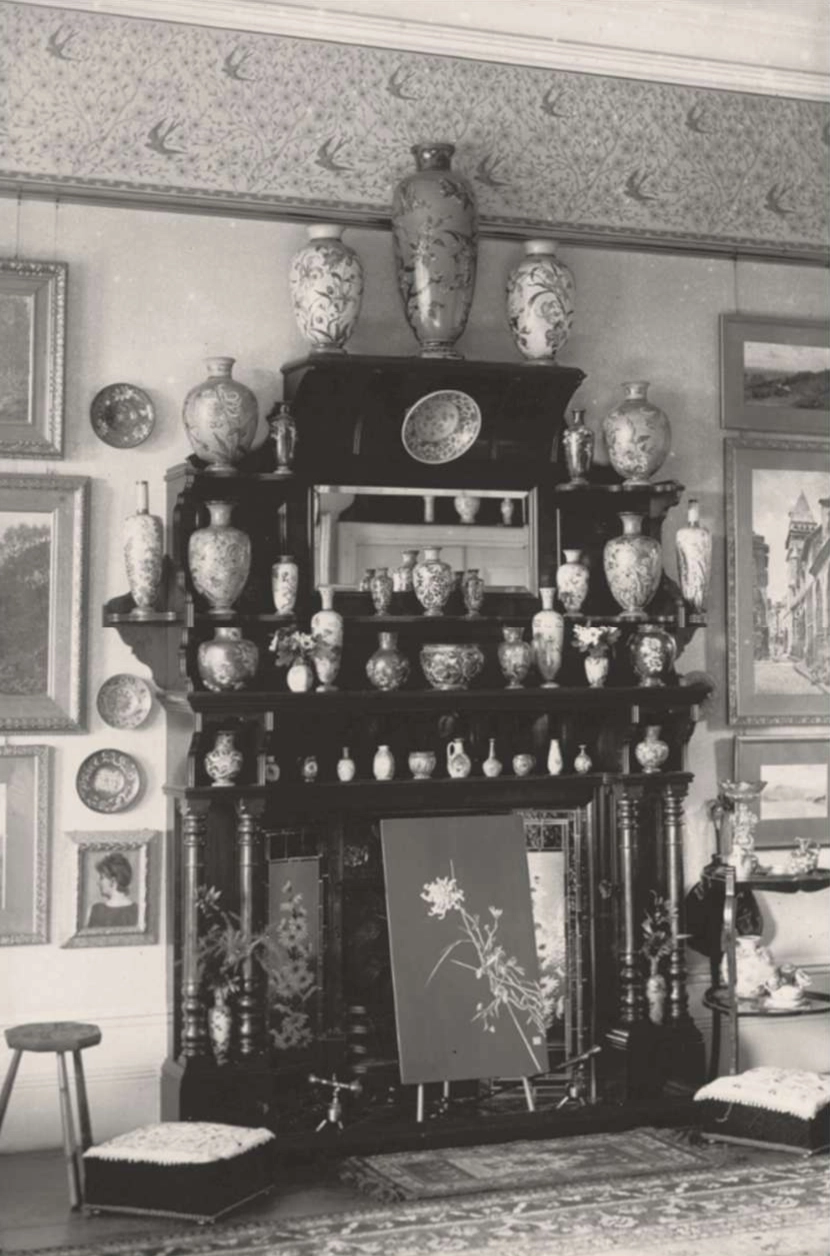
Allen was a fervent collector of the ceramics produced by the Martin Brothers studio and not only is the fire surround covered with their work, but there is an overflow onto the high shelves over the doors into the dining room and with a further substantial collection reputed to have been in Allen’s office at Ruskin House in Charing Cross Road. It might come as a surprise that the apparently conservative Allen had begun to collect work from this small and (then) lesser-known studio, which at the time was producing some bizarre ‘grotesque’ wares alongside the more conventionally styled items.
Besides the elegant Japanese-inspired vases with fish and flower decoration by Edwin Martin that are on prominent display on the shelves here, Allen also owned at least one ‘grotesque’ vase that incorporated four deep relief faces around its circumference, each with a different and curious expression, and two of the eccentric ‘Wally Bird’ lidded jars by Wallace Martin. Theses latter pieces would seem to be unlikely companions to the stylish brass lamps of W.A.S. Benson that brought evening light to the room, or the aesthetic movement-styled border above the picture rail. Beyond that first impression some surviving elements of a not untypical late Victorian parlour remain entrenched and unmoved, where the contemporary influences sit somewhat uncomfortably beside them. As Stephen Wildman quite suggests, ‘These […] other fashionably smart furnishings demonstrate just how far the family had risen in taste and confidence, as well as professional standing and achievement, from their much humbler origins in the Midlands of the young Queen Victoria.’ 9 Yet this interest in modern design and its proponents does fit comfortably alongside what we have already seen with Allen’s influence and choices in the design of his books and bindings, and we need to remind ourselves that although at this time Allen is approaching his seventieth year, his artistic tastes had not stagnated into a desire to retain the past, but were ever open to contemporary views and interpretations.
The walls of both the drawing room and the dining room were covered in paintings. Of these, ninety-two pictures were catalogued for the disposal sales, and there is little surprise to see Ruskin well represented. Among the other fifty-one artists named, there are those of several of Ruskin’s protégées and contributors to his work such as J.W. Bunney, Arthur Burgess, Francesca Alexander, and W.G. Collingwood. There are also works by J.M.W. Turner, Samuel Prout, Birket Foster, Stacy Marks, J.W. Inchbold, Arthur Severn, and the creator of Allen’s own portrait, Fred Yates.
In early 1908, six months after George Allen’s death, his executors began the dispersal of Allen’s collections, beginning with his books and pictures. A catalogue was printed using the handmade paper of Library Edition for a 16-page text section which also listed a limited selection of Allen’s Martinware which was estimated to exceed 100 items. A further 8-page section on coated paper carried monochrome letterpress illustrations of examples of the pottery which, along with the other items, could be viewed by appointment in the Charing Cross Offices. Subsequent catalogues had changes or substitutions as items were sold, and these descriptions and illustrations offer a valuable insight into the depth of Allen’s collections.
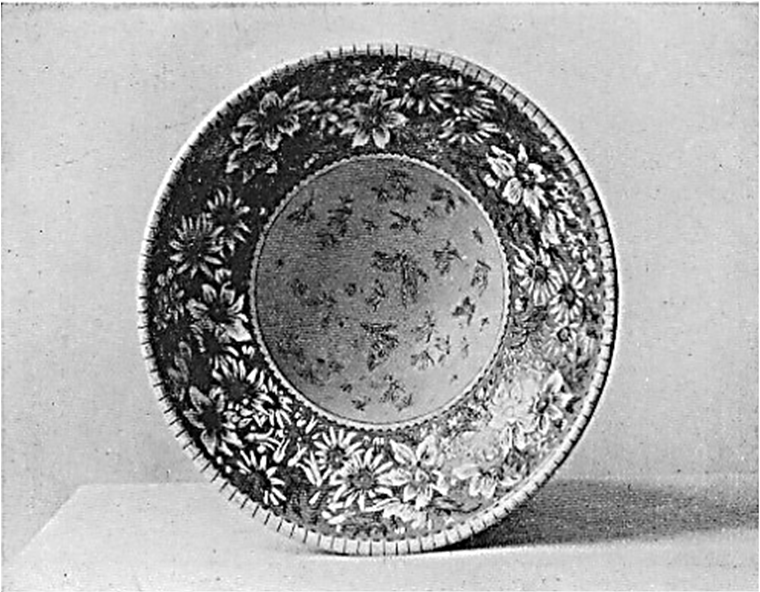
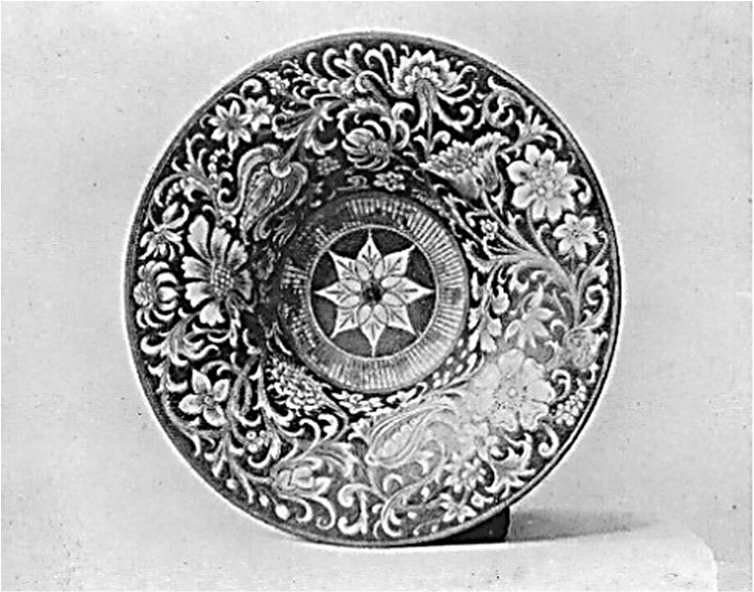
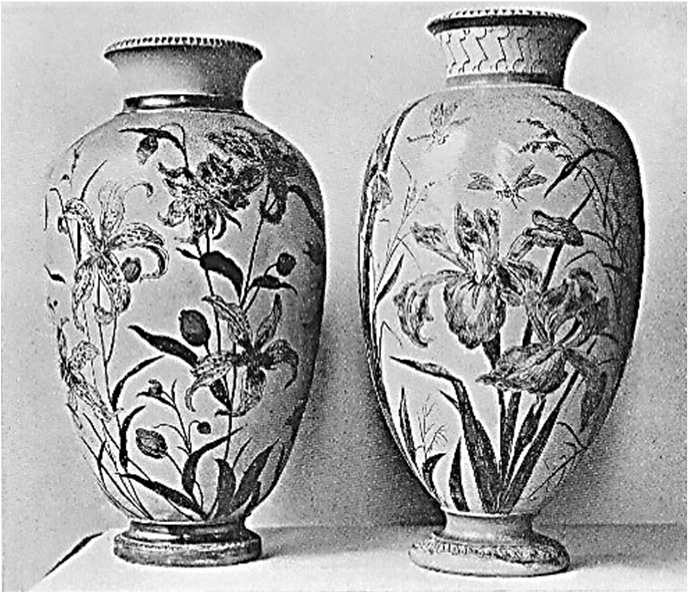
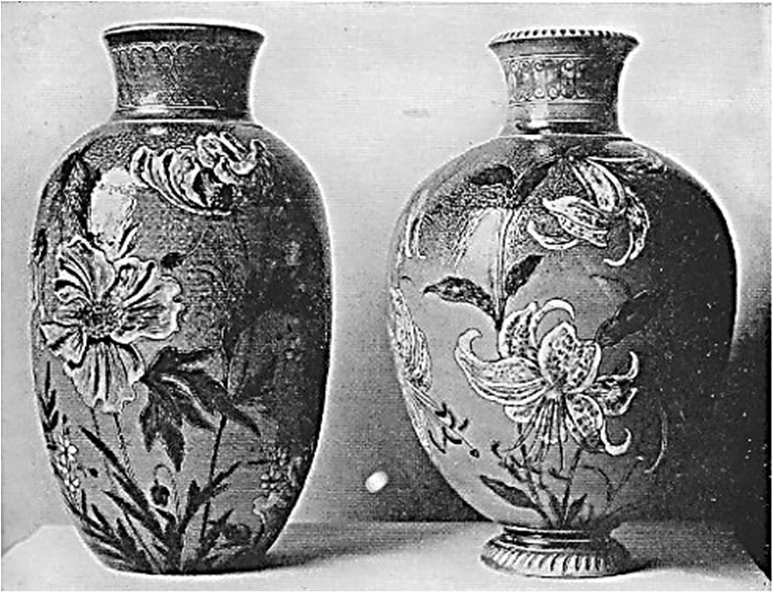
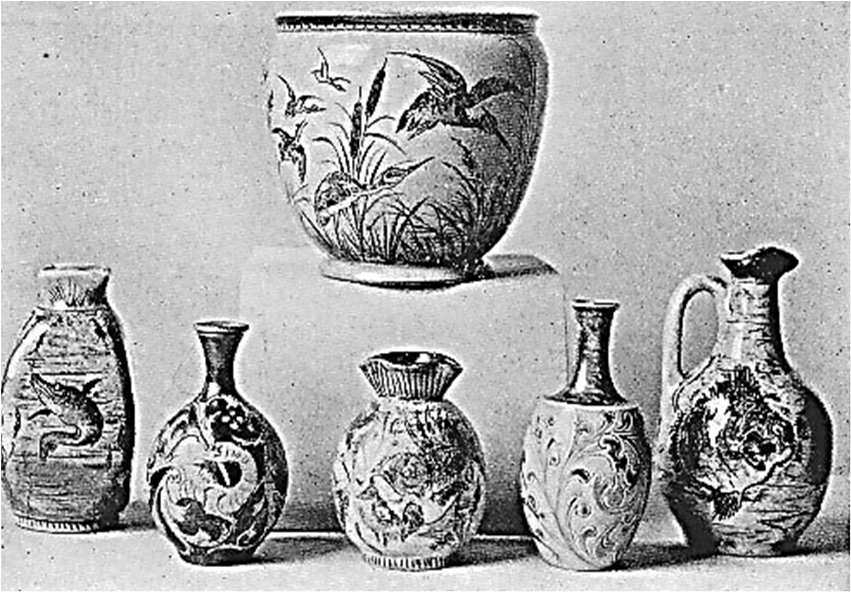
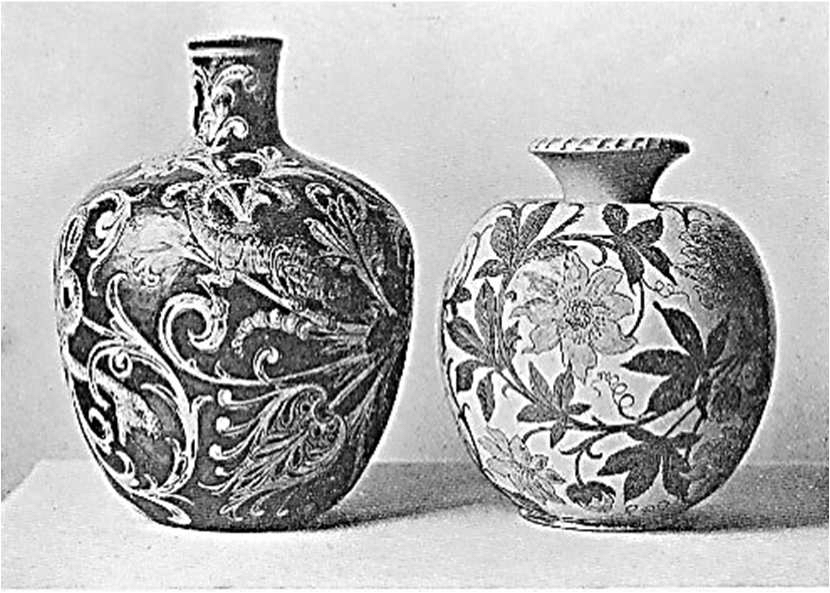
A sample of the vast collection of Martinware pottery.
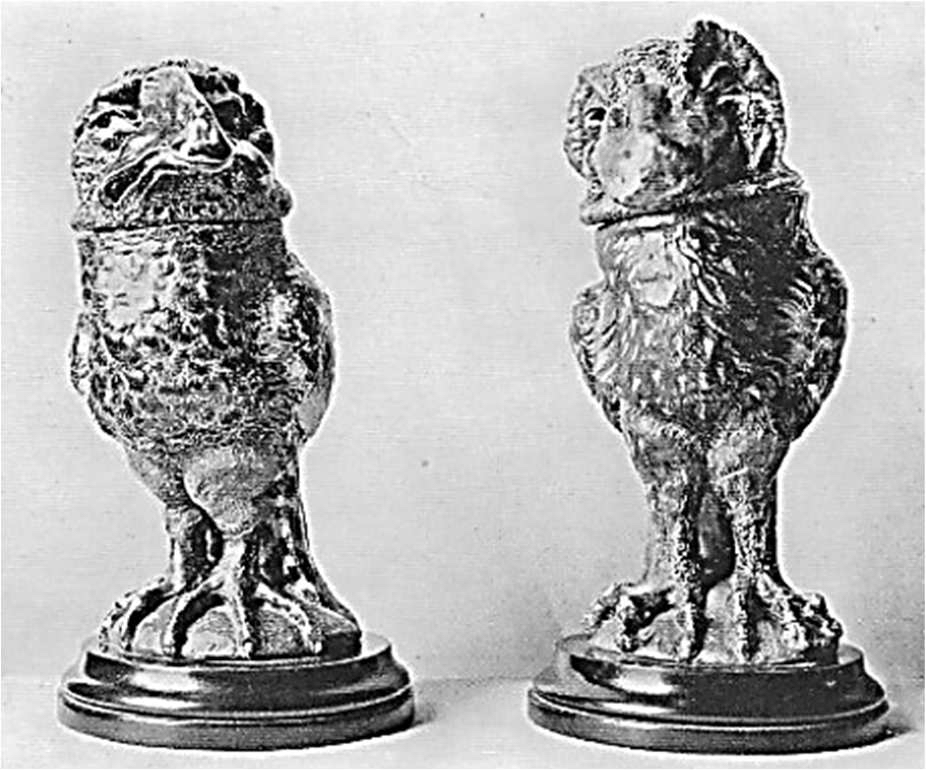
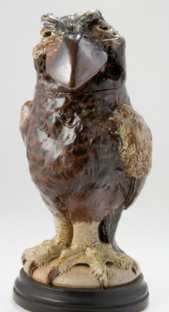
Allen’s Wally Birds (left) as shown in the catalogue and a museum exhibit in colour (right).
With Ruskin as teacher and mentor for much of Allen’s adult life perhaps we should not be surprised that the life enhancing experiences of foreign travel, the engagement with men beyond his natural social boundaries, his exposure to the arts – and in the latter part of his life the managing of successful and profitable business – would have shaped his views and given independence of thought and confidence to his decisions. We have already seen it bear fruit in his publishing with successes in some surprising genres, but perhaps with no greater courage than with his decision to add the works of Edward Carpenter to his list, The Victorian upper-middle class Brighton-born and Cambridge-educated poet and libertarian socialist was born in 1844 but was possibly ahead of his time by more than a century. He was a fascinating character who was interested in eastern religions; supportive of feminism; a vegetarian; an environmentalist who favoured manual labour over machinery, and a theoriser about homosexuality who advocated sexual liberty and who, at the time of the Oscar Wilde trials, was living openly with a male partner. The Art of Creation: Essays on the Self and its Powers was published by George Allen in 1904 and went to a second edition in 1907. Days with Walt Whitman with Some Notes on his Life followed in 1906, and Sketches from Life in Town and Country in 1908 – this last title also under George Allen even though reaching the market a few months after George Allen’s death.
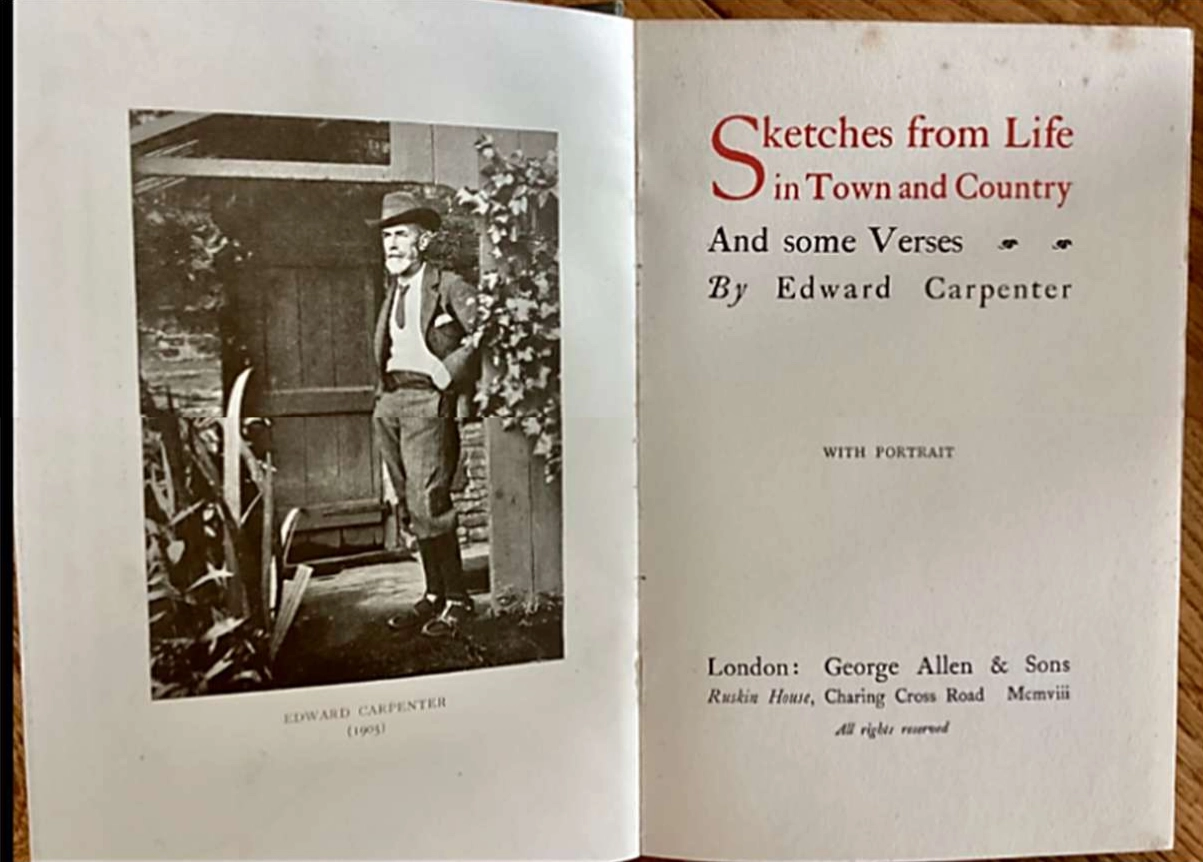
Carpenter was a long-time correspondent with the American poet Walt Whitman (1819-1892). Revered by some as the man who freed up American poetry, and who celebrated the new democratic spirit of a young country and its people, Whitman also famously celebrated the human body and his own ambiguous sexuality. Carpenter was inspired by Whitman and other American writers, such as Emerson and Thoreau, to turn his life around and to ‘live lightly upon the earth.’ Thus, this prolific socialist pamphleteer and campaigner, the seemingly eccentric bearded naturist and pioneer of the sandal as standard footwear, set up home at Millthorpe in the Peak District where he practised self-sufficiency by living off the land. He entertained many of the prominent writers and thinkers of his day at his shared home. “I am living with a man – the best friend I ever had or could think to have – an iron worker, scythe maker and his little family. He often says I wish Walt Whitman would come over here.” 10
Edward Carpenter’s works certainly had a wide readership. Towards Democracy, a collection of poetry, was first published in 1883 by another publishing house before reaching its 17th impression of the fifth edition under the George Allen & Unwin imprint in 1931. It would certainly not be out of place on the shelf near Ruskin’s writings, with two poems standing out in harmony with them: ‘In a Manufacturing Town’ and ‘Sheffield’ both pre-dated Ruskin’s similar thoughts in Storm Cloud of the Nineteenth Century by a year. Civilisation: Its Cause and Cure appeared in 1889 with its fifteenth edition in 1917, also under the George Allen & Unwin imprint, and also a likely comparative volume to rest near Ruskin’s Unto this Last, with any similarities or disparities in their content resulting in many lively hours of conversation had Ruskin and Carpenter ever met. But for Allen, the boldest choice was surely the publishing of Days with Walt Whitman in 1906. Drawn to Whitman’s poetry in his Leaves of Grass, the ever-growing tome that Whitman constantly revised and enlarged throughout his life, Carpenter travelled to America to visit Whitman in 1877 and again in 1884. Whitman was then in his later years and living a quieter and less controversial life, although his reputation persisted. When ‘Leaves’ first appeared in 1855 its references to open sexuality & homosexuality caused something of an uproar in his own country, and when the book reached this country it clearly helped Carpenter to realise that he was not alone with his personal views on life as it could be lived. These views may not have been Allen’s, but unlike Ruskin who refused McFall because he could not agree with her life choices, Allen published Edward Carpenter with his political, social and personal opinions uncensored.
This now-elder statesman of publishing had made his decisions and he stuck by them, having only to answer to himself. On his journey from faithful pupil to successful publisher, Allen had enjoyed an eventful life and gained experiences and acquaintances that never in his youth could he have imagined. He had mixed with the great names of Victorian art. Rossetti taught him how to mix colours and Allen showed Burne-Jones the art of etching. He had spoken with Carlyle. He had demonstrated the art of etching and engraving to Prince Leopold. He had travelled both with Ruskin and by himself many times to France and in the mountains of the Franco-Swiss border. That his liberal mind was open to different views and opinions may well have been what took him from birth in a coaching inn to a gentleman’s villa and from a working carpenter to a fine art engraver, and from there to publishing and rubbing shoulders comfortably with anyone in society’s broad sweep. In another country his success would have been celebrated, and his name better known, but in Britain he remained in Ruskin’s shadow even beyond Ruskin’s death, but remained ever-true to his liberal spirit.
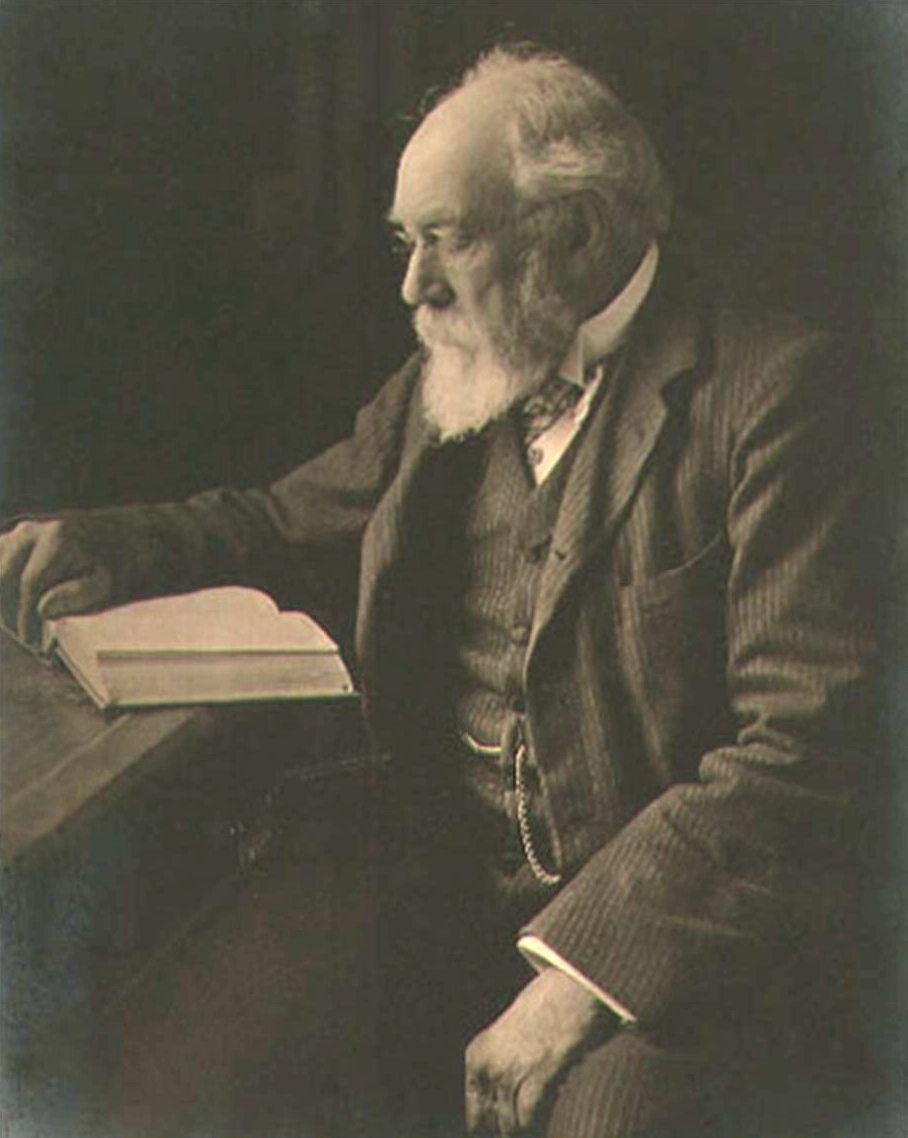
George Allen at his desk. Photo: Ernest Mills, 1903.
© Paul Dawson, 2025.
1 Cook, Edward T. Studies in Ruskin. Orpington and London: George Allen, 1890.
2 John Howard Whitehouse (ed). Saint George: The Journal of the Ruskin Society of Birmingham, vol III, Birmingham: The Ruskin Society, 1900, page 120.
3 John Ruskin to George Allen, January 27th 1884. (Columbia Library, New York)
4 Taken from Tit-Bits, March 31, 1888, p. 399 and referenced in The Library Edition of the Works of John Ruskin volume 34, page 617.
5 George Allen to John Thomas Hobbs. Letter dated October 11th 1887, (The Morgan Library, New York)
6 Bernard Sleigh. Wood Engraving Since Eighteen Eighty. London: Sir Isaac Pitman & Sons, 1932, page 7.
7 Dawson, Paul. Catalogue of George Allen’s non-Ruskin titles. An ongoing project, listing authors, genres, artists and illustrators.
8 William Allen: Letter to The Sidcup Times 30 December 1932 recalling Ruskin’s visit in 1885.
9 Stephen Wildman in the chapter ‘Draughtsman, Engraver and Collector.’ Dawson, Paul with Wildman, Stephen, George Allen of Sunnyside (Lancaster: Ruskin Library, Lancaster University, 2007)
10 Edward Carpenter to Walt Whitman, July, 1880. Charles Sixsmith Collection at the John Rylands Library, University of Manchester.